I have many crystal healing newbies asking what stones should be used with what chakra. The confusion seems to exist because some stones are used for more than one chakra. Different authors and different teachers also have different ideas on what healing crystals should be used for certain chakras.
Below is a list that gives options for the different chakras. Use the stones you have if possible and see how they work. You might find that some stones work better on some chakras - also it might depend on the nature of the healing that should take place and also the recipient of the crystal healing and their attitude/motivation. Experiment and see what works best for you!
Crown Chakra:
Amethyst
Diamond
Herkimer Diamond
Fire Agate
Jade
Labradorite
Opal
Clear Quartz
Purple Howlite
Purple Dalmatian Stone
Selenite
Petalite
Larimar
Pyrite
Smoky Quartz
Ruby
Opalite
Third Eye Chakra:
Amethyst
Carnelian
Emerald
Malachite
Lapis Lazuli
Sodalite
Turquoise
Shiva Agate
Throat Chakra:
Amber
Aquamarine
Citrine
Blue Lace Agate
Turquoise
Sodalite
Blue Topaz
Blue Storm Agate
Fluorite
Clear Quartz
Larimar
Heart Chakra:
Bloodstone
Rose Quartz
Ruby
Chrysoprase
Malachite
Jade
Topaz
Pink Opal
Opal
Emerald
Solar Plexus:
Amber
Citrine
Moonstone
Opal
Golden Quartz
Smoky Quartz
Yellow Jasper
Yellow Fluorite
Yellow Howlite
Yellow Dalmatian Stone
Peach Selenite
Orange Elestial
Orange Millenium Carnelian
Sacral Chakra:
Red Jasper
Amber
Carnelian
Coral
Garnet
Ruby
Red Opal
Red Dalmatian Stone
Fire Agate
Base Chakra
Bloodstone
Labradorite
Smoky Quartz
Jasper
Agate
Lodestone
Hematite
Jet
Black Onyx
Sardonyx
Moqui Marbles
Shungite
Experimentation is the key - you will find that you like certain stones better than others for certain chakras. Let me know what you discover!
www.ciscotraders.net
www.shopciscotraders.com
We are Adventure Traders, crisscrossing the Southwest in search of the odd and obscure to put on our store - Cisco Traders - find us on the internet at www.ciscotraders.net.
Wednesday, November 6, 2013
Tuesday, October 8, 2013
Selenite Healing Crystal - the Spiritual and Meditation Worker of the Mineral Kingdom
Selenite – the
Spiritual and Meditation Worker
Selenite comes from the Greek words “selene” which means
“moon,” and “lithos” which means “stone.”
It was believed to wax and wane with the moon. Selenite is a crystallized form of
Gypsum. It is a very soft mineral and
should be kept dry, never immersed in water.
If Selenite gets wet, it will dissolve.
Selenite has several metaphysical uses – it is believed to
help garner protection from the angelic beings, and help connect with one’s
guides or guardians. It raises one’s
Higher Self and Christ Consciousness. It
protects one from the dark influences and shields the user from negative
energy. During meditation, Selenite can
help one gain access to past or future lives.
It provides a clear picture, letting one see what needs to be done to
resolve a situation. Selenite is an
excellent tool to cleanse and recharge other healing crystals. Selenite never needs to be cleansed or
recharged itself.
Mentally and emotionally, Selenite sooths and comforts. It provides peace and tranquility. Selenite can be used in a grid in the corners
of a room or in a tabletop grid to promote harmony within a home and create a
safe, peaceful environmental for children and family. It can also be used to
strengthen the memory and aid in memory retention.
Physically, Selenite will heal and repair on the cellular
level by removing energy blockages, and is often associated with the spine and
skeletal system. Selenite has been said
to help those with epilepsy by decreasing seizures. It is also believed to be
good for a breast feeding mother.
Selenite can be found in many forms – as a rough stone, a
tumbled stone, made into lamps and candleholders, as a lighted cathedral, wands,
carvings, and as slabs. They are perfect
to use in grids and as an accessory in a room because of their gentle, healing
vibration.
Wednesday, September 25, 2013
Shungite – Merlin’s Magical Stone
Shungite is a rare and exciting stone from the Karelia area
in Russia. Although it may be new to
some of us in the healing crystal world, it isn’t new at all but is 2 billion
years old and was well known to the people of the region. Shungite has been
used in medical treatment since the early 18th-century. Peter the Great, that great czar of Russian,
was known to have used water that had been infused with Shungite. He built Russia's first spa in Karelia to
utilize the water purifying properties of shungite. Peter the Great also instituted its use in
providing purified water for the Russian army. The anti-bacterial
properties of shungite has been confirmed by modern testing.
The origin of Shungite is a mystery – some say it came from
outer space. Others claim it was formed
in ancient oceans and then ended up on land when those oceans dried up.
The origin is less important than what it does. Shungite contains Fullerenes which are
powerful anti-oxidants. Shungite is, in
fact, the only known natural source of Fullerenes in the world. Scientists doing research on Shungite won the
Nobel Prize, their work was considered that important! The use of Fullerenes are being explored for
industrial use in stopping UV damage, to use in solar electric generating
devices, and to help alleviate allergies.
http://tinyurl.com/ow9bl7g
Shungite is said to purify water which is then drunk by the
user for a wide range of health problems including relief from allergies, and
to help skin conditions. It is also
purported to boost energy levels and promote overall healing. Some people claim Shungite will neutralize
any organism within the body that is harmful.
People use shungite to shield them from the electro-magnetic
radiation given off by computers, mobile phone, televisions, and
microwaves. Many people keep Shungite on
both sides of their computer and monitor as protection.
Metaphysically, Shungite is a strong stone for grounding and
connecting one to earth. It can infuse
the auric field with light and allows only positive energy through. It offers psychic protection for those
engaging in astral travel and vision quests.
It is associated with the wizard Merlin and would be a good combination
with Merlinite stone and with Preseli Bluestone, a stone also associated with
Merlin and The Legend of King Arthur.
Wednesday, September 18, 2013
The Evil Eye and What to Do About It
What is Meant by the Evil Eye?
For thousands of years, various cultures have had a term for
the “Evil Eye.” What is meant by
this? Ancient cultures believed that
malicious looks were very powerful and could bring disaster or even death to
the receiver of the “look.” Not just a malicious stare could be considered the
Evil Eye, but also excessive praise and fawning over a person, particularly a
child or newborn baby.
Ancient Greeks and Romans first warned against the Evil
Eye. If one received praise and
admiration that was not warranted, this would manifest itself in mental and
physical disease. Any illness without an
apparent cause was attributed to the Evil Eye.
The Evil Eye works on the premise that if one is gazing at
another with jealousy or evil intent, it can not help but create evil and cause
harm. The Turks believed that there were
two types of the Evil Eye – conscious and unconscious. The unconscious Evil Eye was not intentional,
the person giving the Eye was not intentionally creating it, maybe they just
had jealous pangs as they gazed on a person’s jewelry or clothing or new car. The intentional Evil Eye was, of course, the
most destructive – the person is intentionally staring at a person with the
intent of creating harm and possibly death.
There were several ways to guard against the Evil Eye. Many ceremonies and rituals were put into
place to ward off the Evil Eye and protect against it. Usually people just wore a piece of jewelry
or some sort of talisman to guard against it.
These items were worn or hung in home, and public buildings, and made
into jewelry.
People still believe in the Evil Eye and wear jewelry and
amulets to protection against this ancient evil.
Our Shiva Third Eye Agates are a popular item on our store at www.shopciscotraders.com
Tuesday, September 10, 2013
The Curse of the Blue Diamond
The Curse of the Blue
Diamond
Crystals and gems have been allegedly cursed throughout
history. One of the greatest legends is
that of the Hope Diamond aka as the French Blue or Blue Diamond, which has to
be the world’s most unlucky gemstone. The fabulous color – blue – is because of
small amounts of boron within its crystal
structure; it also exhibits red phosphorescence after exposure to ultraviolet light.
There are varying accounts of the diamond and the curse but
here is my favorite:
Legend has it that a French trader, Jean-Baptiste Tavenier,
stole the diamond (originally 112.5 carats) from the eye of an idol in the
Temple of Rama Sitra. The bad luck
starts here with Jean-Baptiste going bankrupt, and sailing for India to reclaim
his fortune. He died on the ship to
India, a pathetic and broken man. Another
report claims Jean-Baptiste was torn apart by wolves!
(However, Susanne Patch, author of Blue Mystery: The Story of the Hope Diamond, says that the diamond
is unlikely to have ever come from the head of an idol or statue which blows
the whole curse theory but I digress….)
Before his death, Jean-Baptiste sold the stone to Louix XIV
in 1668. Louis XIV had the diamond cut
into a heart shape and let his mistress wear it. His mistress, Madame de
Montespan, became embroiled in a rather
outrageous scandal. It was alleged that
the Madame was somehow involved with some older women who provided Black Magic
potions or poisons for disposing of unwanted husbands and lovers. Ouch! Madame de Montespan fell out of the king’s
favor as a result of the scandal. The
other women involved were tried in court secretly and burned at the stake!
Louis’ descendant, King Louis XV had the jewel reset but it
fell into disuse after his death. His
grandson, King Louis XVI, let his wife, Marie Antoinette wear it although there
is some disagreement about whether she
really wore it or not. In any event, both
Louis and Marie were beheaded in 1793.
It was believed stolen after that and missing for twenty
years.
In 1830 the diamond surfaced again but had been reduced from
112.5 carats to 44.5 carats. Henry Thomas
Hope, a banker, purchased the stone for 18,000 pounds. At that point, it became known as the Hope
Diamond. Hope and his family survived
the diamond – that is, until the popular singer May Yohe, married Lord Francis
Hope. The Hopes had marital problems
from the beginning and May gave a prophecy that the diamond would bring bad
luck to anyone who owned it. May ran off
with another man, and died in poverty, always blaming the diamond and never her own poor choices. Lord Francis himself was in a lot of financial
trouble as a result of overspending and having a lavish lifestyle and sold the diamond in the early 1900s.
The next owner, Jacques Colot, a French broker went insane
and committed suicide. But it is
believed he sold it to the Russian Prince Kanitovsi first. The Prince lent it to a French actress at the
Folies Bergere who was shot by the Prince himself from his own box the first
night she wore it! He didn’t fare so
well either as he was shot by revolutionaries.
Simon Mantharides, a Greek jewelry, then bought the diamond
and met his demise over the edge of a cliff – accident or homicide?
A Turkish sultan, Abdul Hamid aka Abdul the Damned, bought
the gemstone in 1908 and was deposed the following year. But first he went insane!
The next owner Habib Bey, drowned.
An American purchased it next, Edward Beale Maclean, owner
of the Washington Post. His mother
immediately died thereafter as did two servants in his household. His ten year old son, Vinson, ran out of the
house and was hit by a car and killed.
Maclean and his wife, Evelyn, separated, he was plagued with scandal,
and became an insane alcoholic, committing suicide. Evelyn kept the diamond and dismissed curse
stories as bizarre fabrications. However,
her daughter committed suicide in 1946.
People noted that Evelyn had worn the diamond to the young woman’s
wedding. Evelyn died in 1947.
Harry Winston, a New York jeweler, bought all of Evelyn’s
jewelry and presented the Hope Diamond to the Smithsonian in 1958 where it is still
exhibited for the viewing public (Hope Diamond in its new setting – see below).
What a wild story!
There are several legends concerning the Hope Diamond, some without any
curse mentioned at all.
It is a beautiful stone with or without the curse.
References:
Patch, Susanne. Blue
Mystery: The Story of the Hope Diamond
Wikepedia
Tuesday, April 2, 2013
Pony Express and the Butterfield Overland Mail Company - What's the Difference?
What is the difference in the Pony Express and the Butterfield Overland Mail Company?
Well, the similarities are that they both brought mail out West from the East Coast of the United States. There the similarity ends.
The Butterfield Overland Mail Company had the U.S. mail contract for six years from 1857 - 1861. In all, it employed 800 people at its peak with over 1800 horses and mules in service. There were 139 relay stations. The last run was made on March 21, 1861 right before the Civil War started.
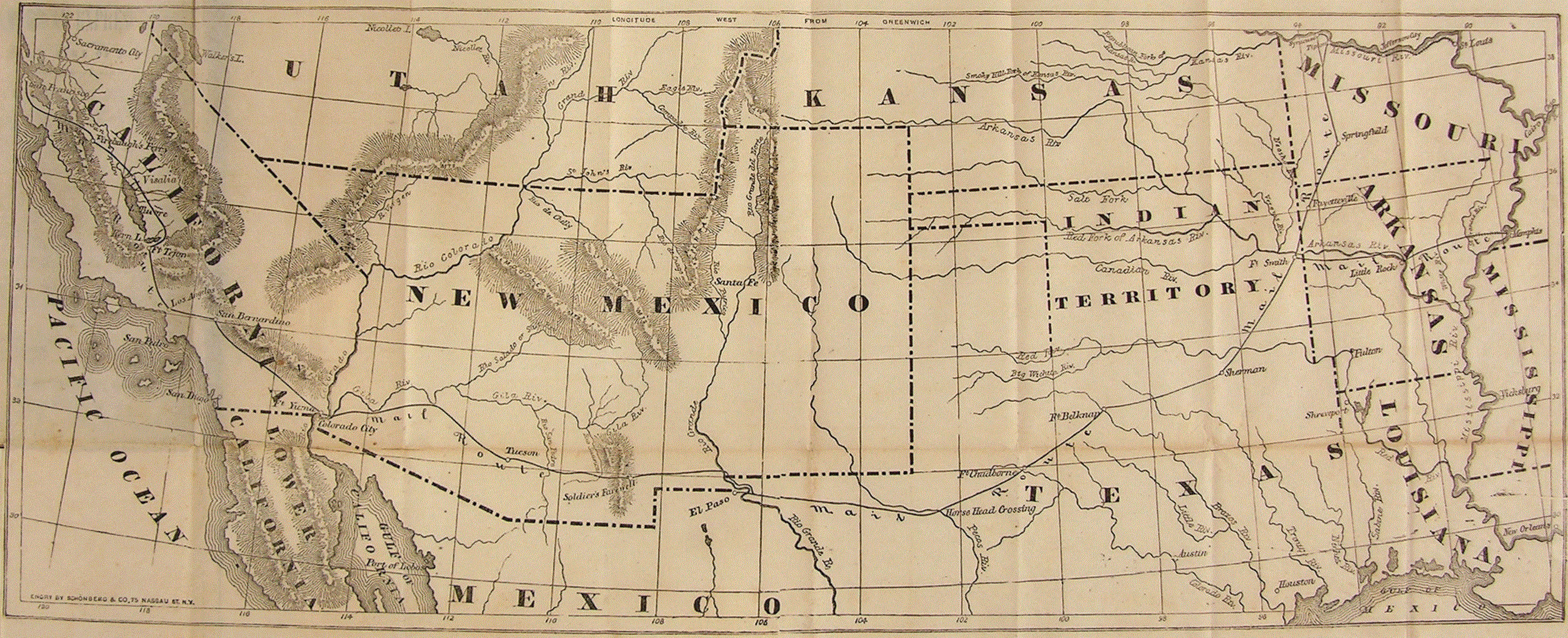
The Butterfield Overland Mail Company went from Tipton, Missouri to San Francisco, California and did go through Arizona, unlike the Pony Express. It crossed into Arizona to Yuma, crossed the Colorado River, and then up the coast of California to San Francisco. The big problem with the Overland Mail Company was that it used stage coaches to deliver the mail and took 24 days, and was constantly harassed by bandits and Apache Indians. One rider described the journey as"now knowing what Hell was like." With the looming certainty of the Civil War, the Butterfield Overland Mail Company was discontinued and the Pony Express began, a more expedient way to deliver the mail.
There are surviving stations at Oak Grove and Warner Springs, California. Warner Springs in San Diego County has been declared a National Historic Landmark with two original adobe buildings. There is a proposed Butterfield Overland Trail National Historic Trail now in the works.
The Pony Express operated in 1860 until 1861 and became the Western United States's fastest means of communication with the rest of the country until the telegraph became established in 1861. The Pony Express took about 10 days to deliver the mail. The riders had to be tough - the advertisement for Pony Express riders was the following -
Wanted: Young, skinny, wiry fellows not over eighteen. Must be expert riders, willing to risk death daily. Orphans preferred.
Each rider was presented with a Bible and took an oath not to cuss, drink, gamble, or be mean to animals.
The Pony Express route went over the top of Arizona and went through Nevada due West. The most famous Pony Express rider was probably Buffalo Bill Cody who memorialized it in his autobiography and Wild West Shows.
Friday, March 29, 2013
Mojave Mike Climbs Obsidian Hill
Mojave Mike had a great idea to check out Obsidian Hill over by the Salton Sea the other day so off we went. With my knee, I was not up for the trek, but Mojave Mike hiked it and brought back some samples.
Here is a photo of Mojave Mike hiking up the hill. You can see the chunk of obsidian at the top.
Sample of Obsidian that Mojave Mike brought back to car
Obsidian is a naturally occurring volcanic glass formed as an extrusive igneous rock, the result of cooled lava. Obsidian is hard and brittle; it is sharp! So if you go exploring up there, wear gloves if you want to pick up the obsidian. It is mineral-like but not a true mineral because it is a glass and does not have a crystalline structure and is sometimes classified as a mineraloid. Obsidian is usually dark in appearance, dark brown or black, but can vary. Sometimes the inclusionn of small, white clustered crystals of cristobalite in the black glass gives a snowflake pattern, hence, you have Snowflake Obsidian.
Snowflake Obsidian available from www.ciscotraders.net
Obsidian is used for knife blades and for scalpel blades for research or surgery on animals (not approved by FDA for human surgery) and to make jewelry and decorative items. Metaphysically, it is purported to be the "stone of truth" and also to dispel negativity.
Obsidian Hill is a small hill located on Red Hill Island which is a small island located off the eastern shores of the Salton Sea in southeastern California. The Salton Sea itself was actually formed by a canal breach from the Colorado River during a big flood. The area was a depression (below sea level) and so filled up with water. The water is very salty and full of chemicals due to the local farming runoff. Not a good idea to go wind surfing in this water! Anyway, it is very smelly and not so pleasant although the day we were there it was nice and breezy and not unpleasant at all, it was actually quite nice.
Mojave Mike surveys the Salton Sea
The Salton Sea is a waypoint for migrating birds; much of the Salton Sea is managed as the Sonny Bono Salton Sea National Wildlife Refuge. We even saw a HUGE pelican swimming merrily along. This thing was ENORMOUS, we were easily 1000 feet away from it and look how big it was!
But I digress....
Red Hill Island is a cool place with some interesting rock formations.
How to get there:
Go on state highway CA 111. About halfway between the towns of Niland and Calipatria, turn west on Sinclair Road, go about three miles on Garst Road, and go north 1.5 miles to Red Hill Road. Go west on Red Hill Road to the island. You will see Obsidian Hill at this point and follow it around to see Red Hill Island and the Salton Sea.
Along the way you will also see the Mudpots, bubbling away. It is signed with "No Trespassing Keep Out" signs but no one seems to heed the warnings. There were about five people out there that day on the site. Very cool place but creepily has some huge cracks in the ground, making me wonder if I would be a Mudpot Sinkhole victim! Luckily, we made it out okay but not before Mojave Mike was sprayed with hot mudpot goo when he got too close filming one of the mudpots!
All along those roads and at the Salton Sea you will see the Geothermal Power Plants. There are a total of seven plants and the steam plumes are clearly visible from many miles away. Very awesome sight to behold!
Subscribe to:
Posts (Atom)